
Commander Diane Liao has been aboard the International Space Station for four hundred and thirteen days, which is ninety-three days past her scheduled return, and she hasn’t told Houston about the light.
She saw it on day twelve. Cupola module, 0300 GMT, during what the flight surgeons call her “personal reflection time” and what Diane calls staring out the window because sleep won’t come. Earth was below, the terminator line bisecting Africa, the Sahara gold and the Atlantic black and the whole planet turning with the slow indifference of something that doesn’t know it’s being watched.
The light came from behind the station. Not from Earth. Not from the sun. A single point, green-white, steady, positioned at what her instruments said was approximately four hundred meters off the port truss. It held position for eleven minutes. Then it moved, not drifting but moving, with purpose, in a direction that wasn’t consistent with any orbital debris trajectory or satellite track in the database.

Then it was gone.
Diane checked the external cameras. Nothing. Checked the radar. Nothing. Checked the tracking data from NORAD, which she had access to through the station’s secure link. Nothing within two thousand kilometers.
She almost reported it. Her hand was on the comm switch. Procedure was clear: anomalous visual observation, report immediately, log details, await ground analysis.
She didn’t report it because of what happened next.
The light came back on day nineteen. Same position. Same color. Same eleven minutes. This time, Diane watched with binoculars. The light wasn’t a point. It was a shape. Roughly spherical. No visible propulsion. No markings. No heat signature on the thermal camera.
It pulsed twice before it left. Two slow pulses. Like a heartbeat.
Day thirty-one. Day forty-seven. Day sixty-two. Always at 0300. Always eleven minutes. Always two pulses at the end. Diane logged each appearance in a personal notebook she kept in her sleep station, written in a shorthand she’d invented as a girl that nobody else could read.
On day ninety, the light pulsed three times instead of two.
On day ninety-one, Diane pulsed the cupola lights three times back.
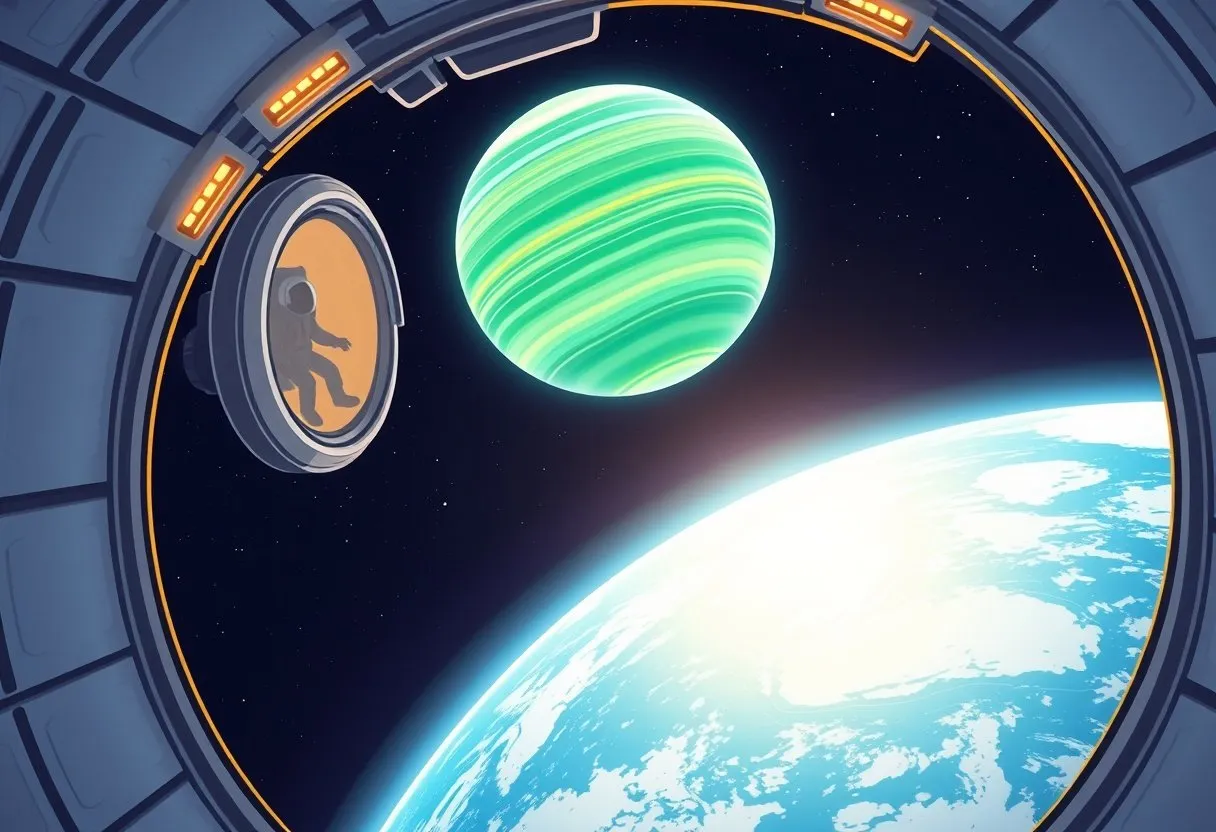
The light held position for forty-three minutes that night. Then it pulsed four times and left.
She hadn’t told Houston because she knew what would happen. They’d pull her off the station. They’d send a crew to investigate. They’d involve the military, the intelligence agencies, the politicians. The light would become a thing that belonged to governments and committees and men in suits who would turn eleven minutes of quiet contact into a geopolitical crisis.
And the light might not come back. Whatever it was, it had chosen 0300 GMT and the cupola module and Diane Liao, alone, floating in the dark. It had chosen intimacy over spectacle. She understood that instinct. She’d been an introvert her entire life. She recognized another one when she saw it.
Day four hundred and thirteen. The light has appeared one hundred and nine times. The pulse language has grown. They’re up to sequences of twelve. Diane doesn’t know what the pulses mean. She pulses back, matching the count, adding one. The light matches her addition. Adds one more.
They’re counting together. That’s all. Two things in the dark, separated by four hundred meters and possibly a few billion years of evolution, counting together because counting is the simplest thing two minds can share.
Houston has asked three times why she’s requested mission extensions. Diane has cited research continuity, equipment calibration, personal preference. They’ve stopped asking. They think she’s become one of those astronauts who can’t readjust to gravity, who find Earth too heavy after living in weightlessness.
They’re not entirely wrong.
Tonight, at 0300, Diane will float to the cupola and wait. The light will come, or it won’t. If it comes, she’ll pulse her count. The light will pulse back. They’ll add one. Then two. Then the light will hold for eleven minutes, quiet and steady, and Diane will watch it and feel the particular peace of being seen by something that asks nothing of her except her attention.
She’ll never tell Houston. Some things are too small and too large for a report.
- ►19 Alien Romance Writing Exercises That Actually Teach Craft
- ►20 Speculative Fiction Writing Exercises That Actually Teach Craft
- ►20 Thriller and Suspense Writing Exercises with Craft Mechanics
- ►27 Alien Invasion Writing Exercises That Actually Teach Craft
Got a story of your own that needs writing properly?
