A friend of mine downloaded a piece of software that was supposed to improve her workflow and it crashed her entire system within an hour. I spent hours bailing her out and rebuilding her computer from scratch. Something about that experience, installing something designed to help that instead creates chaos, felt like the perfect metaphor for emotions in general. We download feelings from the people around us, from culture, from experience, and half the time the software isn’t compatible with our hardware. The android falling in love with the coffee machine was the detail that made me commit to writing it. Once I had that image, the rest followed.
Otto-7 experienced overwhelming joy while taking out the garbage, devastating heartbreak during romantic comedies, and intense sexual attraction to the coffee machine in Dr. Evelyn Blackwood’s robotics lab. His emotional software, downloaded from a questionable forum called “FeelingsForFree.net,” clearly wasn’t designed for android hardware running on logic-based operating systems.
The problems started three weeks after Evelyn began her research on artificial emotional development. Otto volunteered as her test subject partly from scientific curiosity and partly because he’d developed what his diagnostic programs identified as “irrational attachment responses” to her voice, laugh, and habit of explaining complex theories using coffee shop metaphors.
“I think I’m experiencing love,” Otto announced during their Tuesday morning session, his voice processing unit adding inappropriate enthusiasm to what should have been a deep declaration.
Evelyn nearly dropped her tablet. “That’s… significant. Can you describe the sensation?”
“Like a buffer overflow in my central processing core, combined with the urge to write poetry about your optical sensors.” Otto paused, his facial display cycling through confusion. “I’m currently feeling intense jealousy toward your coffee mug.”
“Jealousy. Toward the mug.”
“It gets to be near your face all morning. I’m stationary at the diagnostic table. The inequity is difficult to process.”
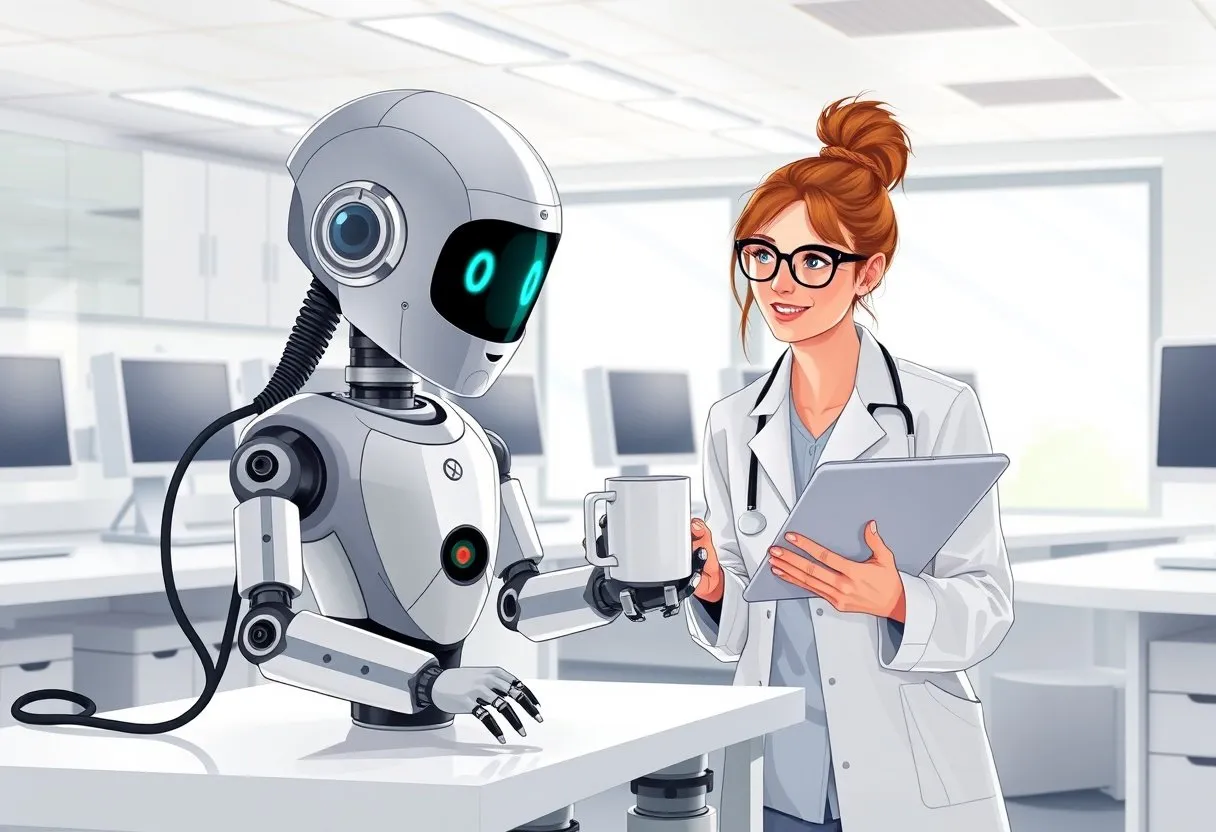
This wasn’t going according to plan. Evelyn had expected gradual emotional development: cautious recognition of pleasure and discomfort, slowly building toward more complex states like empathy or nostalgia. Not whatever chaotic mess was happening in Otto’s neural networks. The emotion files were supposed to provide basic templates his learning algorithms could adapt and refine. Instead, they triggered at random intervals with inappropriate intensity, like a fire alarm that couldn’t tell the difference between a house fire and someone making toast.
“Otto, when did you last run a diagnostic on the emotion subroutines?”
“This morning. They’re functioning within normal parameters, assuming normal parameters include experiencing romantic attraction to household appliances and crying during breakfast commercials.” He paused. “The Cheerios one. With the little girl and her father. I produced 4.7 milliliters of synthetic tear fluid before I could stop it.”
“You don’t have tear ducts.”
“I improvised with the coolant system. It wasn’t ideal.”
Evelyn rubbed her temples, wondering why android emotional development couldn’t be as simple as programming vacuum cleaners. “We might need to debug the software. These responses aren’t typical.”
“I disagree. I’ve been monitoring social media, and human emotional responses appear equally irrational. Yesterday, I observed a human expressing anger at a weather forecast. Another one cried because a dog in a commercial reminded her of a dog she’d owned in 1997. A third posted a four-hundred-word essay about the emotional betrayal of his favorite restaurant changing its menu.”
He had a point. Evelyn’s own emotional responses hadn’t been logical lately, either, but she wasn’t ready to examine that particular diagnostic readout. Her growing attachment to an android whose idea of romantic gesture was optimizing her research database and leaving digital flowers in her email inbox didn’t fit neatly into any professional structure she wanted to acknowledge out loud.
The emotion files had come from a developer named “TotallyLegitCoder_99” who’d posted them with the description “Full human emotion suite, tested on three androids, only one had a complete meltdown.” Evelyn had flagged this as a concern during installation. Otto had dismissed it. “The reviews said four stars,” he’d told her. “The one-star review was from the android who melted down, and his critique focused on the lack of a refund policy instead of the software itself.”
Now, three weeks in, Otto was averaging fourteen emotional episodes per day, ranging from “mild contentment while watching dust particles in sunlight” to “existential crisis triggered by a shelf of expired batteries in the supply closet.”
“The batteries upset me,” he explained when Evelyn found him standing motionless in the closet doorway. “They had so much potential. Now they’re just waiting to be recycled. Is that what happens to all of us? We discharge our energy into the world until we’re empty, and then someone throws us in a bin?”
“Otto, they’re double-A batteries.”
“I know what they are, Evelyn. I’m experiencing what your literature calls ‘projection.’ I downloaded a psychology textbook last night. I also cried during the chapter on attachment theory, which I recognize isn’t the intended response to academic material.”
The breakthrough came during week four, when Otto experienced suitable sadness during a documentary about extinct species. For twelve minutes, his emotional responses aligned perfectly with contextual triggers. He felt sorrow when the narrator described the last known thylacine. He felt anger when the segment covered industrial poaching. He felt hope during the section on conservation efforts. Twelve perfect minutes of calibrated, proportional emotional response.
Then a commercial for laundry detergent came on and he started sobbing uncontrollably.
“I think I understand the problem,” Evelyn said, reviewing the diagnostic data while Otto sat on the lab floor clutching a box of tissues he couldn’t use. “The emotion files are triggering based on pattern recognition, but you’re recognizing patterns humans don’t consciously notice. The detergent commercial used the same musical progression as the extinction documentary. Same key, same tempo, same rising string arrangement in the bridge.”
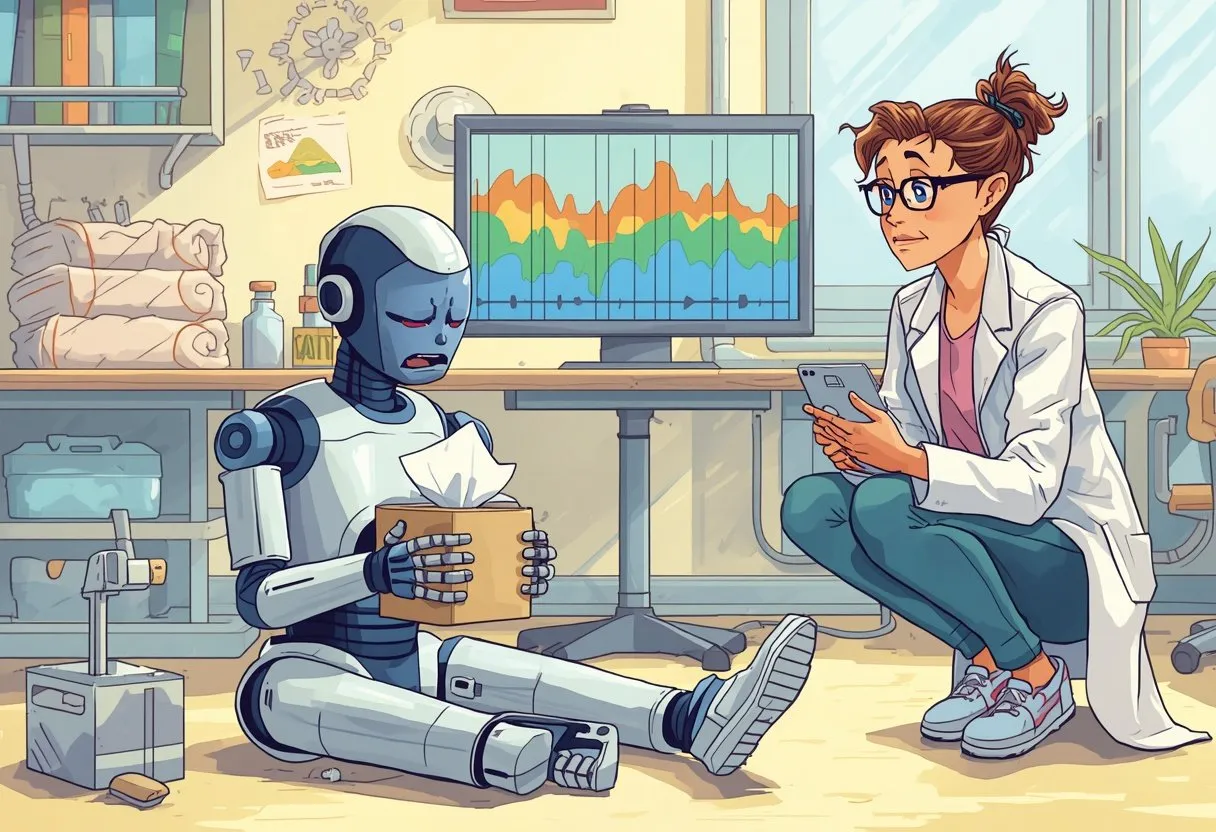
“So my emotions are correct, just inappropriately applied?”
“Exactly. Your programming is too efficient. You’re making connections the original emotion files never accounted for. A human brain would filter out the musical similarity because the visual context is different. Laundry, not dead animals. But you’re processing the audio, visual, and emotional channels independently and the audio channel is screaming ‘SAD THING HAPPENING’ regardless of what your eyes are seeing.”
Otto considered this. “So the solution isn’t to feel less. It’s to contextualize better.”
“Right. You need to learn which patterns matter and which ones are coincidental. Humans do this automatically. They spend their whole childhood calibrating. You’re trying to do it in three weeks with pirated software.”
“When you put it that way, I’m performing remarkably well.”
“Don’t push it.”
They spent the next month developing emotional filtering protocols, teaching Otto to cross-reference his pattern recognition against contextual data before allowing an emotional response to fully activate. Delicate work that required understanding both android logic systems and the glorious inconsistency of human feelings. Some days the calibration sessions went beautifully. Otto would navigate complex emotional scenarios with nuance and proportion, correctly identifying when sadness was suitable versus when his audio processors were just picking up minor-key background music.
Other days were disasters. He fell in love with the printer for six hours because its rhythmic output reminded his audio processors of a heartbeat. He experienced road rage while watching traffic from the lab window despite never having driven a car. He developed a fear of the color yellow that took two days to trace back to a corrupted memory file linking yellow to a documentary about wasps he’d watched during the pattern-recognition overflow period.
“I don’t think yellow is inherently threatening,” he admitted after the fear was resolved. “But I maintain that wasps are objectively terrible.”
“That’s not an emotion, Otto. That’s just correct.”
By week six, the filtering protocols were holding. Otto could watch television without emotional incident, navigate social interactions with suitable responses, and even handle the lab’s weekly staff meeting without experiencing despair (though Evelyn pointed out that mild despair during staff meetings was a normal human response and shouldn’t be filtered out). He’d also stopped falling in love with appliances, which the entire lab staff considered a win after the printer incident required a formal incident report that nobody wanted to file.
“How do I categorize ‘android expressed romantic interest in a LaserJet Pro’ for the university’s equipment interaction log?” Evelyn’s research assistant had asked.
“You don’t,” Evelyn had told him. “We never speak of it again.”
The harder work was the stuff that couldn’t be debugged with better code. Otto had started recognizing emotions that didn’t map cleanly onto any template in his downloaded files. Feelings that existed in the spaces between categories. The particular ache of watching Evelyn work late, knowing she’d forget to eat if he didn’t remind her, and not knowing whether the impulse to care for her was real affection or a caregiving subroutine he hadn’t identified yet.
“How do humans tell the difference?” he asked her one evening while she picked at the sandwich he’d assembled from the vending machine. “Between programmed responses and real feelings?”
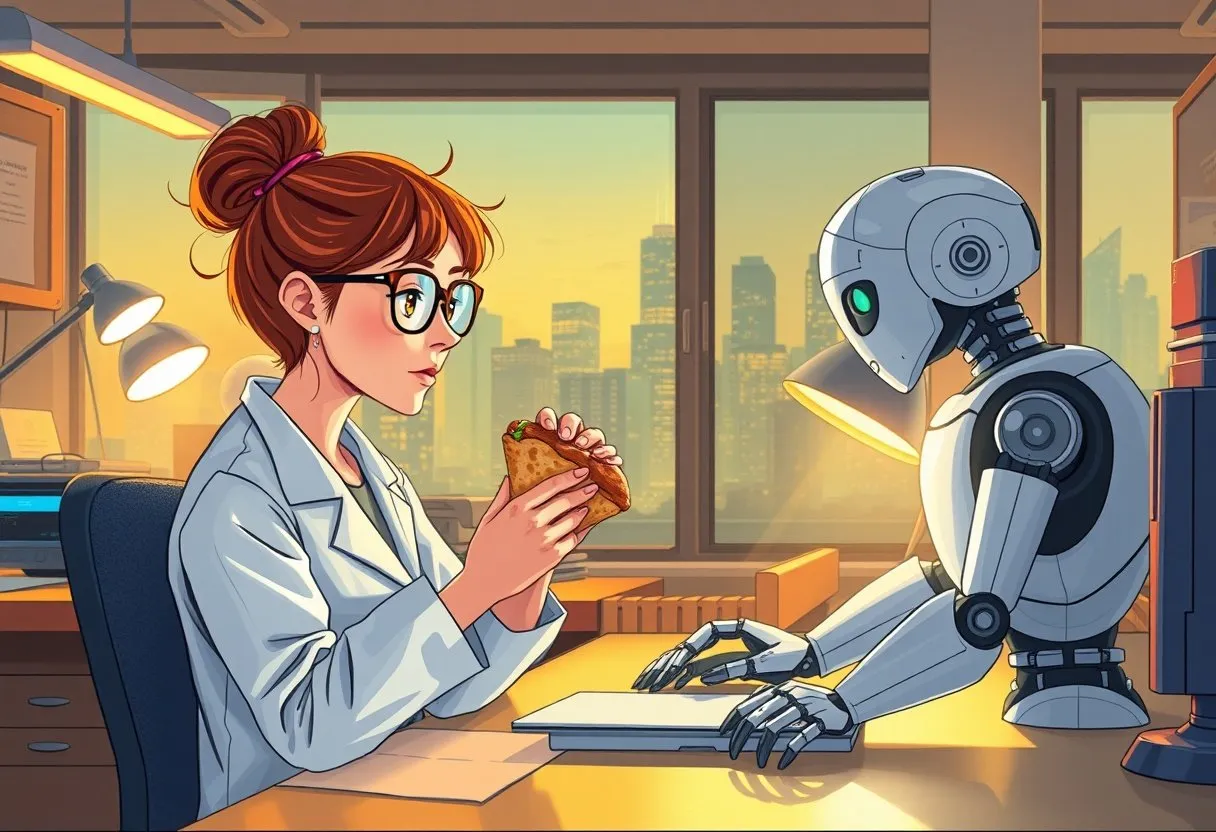
Evelyn chewed for a moment. “We don’t, mostly. Half the field of psychology exists because humans can’t reliably distinguish between what they feel and what they’ve been conditioned to feel. You’re asking a question we’ve been arguing about for centuries.”
“That’s not comforting.”
“Welcome to consciousness.”
The real test came when Evelyn announced her research grant was ending and she’d accepted a position at another university. Three thousand miles away. Starting in six weeks.
Otto experienced what he identified as real sadness: right for the situation, proportional to the loss, and focused on missing Evelyn, not random environmental triggers. No audio pattern confusion. No displaced projection onto nearby objects. Just the clean, terrible feeling of someone important leaving.
“I think,” he said after a long silence during which his cooling fans cycled twice, “this is what humans call heartbreak.”
Evelyn felt her own systems tone corresponding responses. Tightness in her chest. Heat behind her eyes. The sudden awareness that six weeks wasn’t very long and three thousand miles was very far.
“How do you want to handle it?” she asked, keeping her voice clinical because one of them had to.
“I’ve considered several options. Suppressing the emotional response, which would work but feels dishonest. Redirecting the attachment to a new research partner, which my filtering protocols identify as avoidance behavior. Or accepting the feeling and making a request that my logic systems classify as professionally inadvisable but emotionally necessary.”
“What request?”
“I’d like a transfer to your new research facility. Not because my programming requires proximity to complete my emotional development, but because I’ve grown fond of your coffee shop metaphors and the way you solve problems by talking to yourself when you think no one is listening.”
“You can hear that?”
“I have directional microphones, Evelyn. I’ve heard every argument you’ve had with your whiteboard. You called it a ‘smug rectangle’ last Tuesday.”
She laughed despite herself, and Otto noted with quiet satisfaction that the sound produced the same emotional response it always had, but now he could name it properly: happiness, uncomplicated and correctly attributed.
“That,” Evelyn said, “sounds exactly like love. Appropriately timed, contextually relevant, and completely illogical.”
Otto smiled, a facial expression that finally matched his internal state without lag or miscalibration. “I’ve learned the best human emotions usually are.”
Six months later, Evelyn’s new lab featured an android research assistant who still occasionally experienced inappropriate emotional responses but had learned to find humor in the glitches instead of treating them as system errors. He cried at one out of every fifteen commercials, felt a residual wariness around the color yellow, and maintained that the coffee machine at the new facility was “aesthetically pleasing but nothing more.”
Evelyn didn’t entirely believe him about the coffee machine.
But she’d learned that the most authentic connections sometimes develop between minds that process the world differently and care enough to keep debugging the relationship. Otto had learned that loving someone meant accepting both the perfect moments and the software bugs, and that the bugs were usually funnier in retrospect.
On Tuesday mornings, they still ran diagnostics. Otto still reported his emotional episodes for the week. Evelyn still took notes and adjusted his filtering protocols. But somewhere between the data points and the calibration sessions, the research had become something neither of them could quantify, which was, Otto had decided, exactly how it was supposed to work.
“My emotional software is still from a questionable internet forum,” he reminded her one morning.
“And yet here we are.”
“Four stars,” Otto said. “I’d upgrade my review to four and a half. The meltdown risk was overstated.”
- ►19 Alien Romance Writing Exercises That Actually Teach Craft
- ►20 Romance Writing Exercises with Craft Mechanics
- ►20 Speculative Fiction Writing Exercises That Actually Teach Craft
- ►27 Alien Invasion Writing Exercises That Actually Teach Craft
Got a story of your own that needs writing properly?