TL;DR
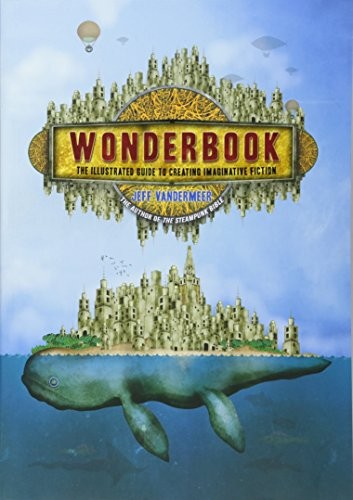
8/10. The most visually inventive craft book ever made, and the best on writing imaginative fiction. Its full-color illustrations teach story concepts prose cannot, and it takes the fantastic seriously. Diffuse instead of systematic, large and pricey, and not a first craft book. For speculative writers with the basics down, a treasure.
Open Wonderbook to any page and you’ll see something no other writing book contains: a full-color illustration of an idea you thought could only be explained in words. Jeff VanderMeer’s guide to writing imaginative fiction, fantasy, science fiction, the surreal and the strange, is the most visually inventive craft book ever made, and that’s not a gimmick. The illustrations do real teaching work, diagramming abstract concepts of story in a way prose alone cannot. Most craft books are gray walls of text. This one looks like it was built by someone who loves the strange as much as the writer holding it.
VanderMeer is an award-winning writer of weird and speculative fiction, and the book reflects a sensibility very different from the brisk, structural, market-minded approach of something like Save the Cat. Where that book gives you a blueprint, this one gives you a way of seeing, and the two couldn’t be more different in temperament.
What the pictures do
The illustrations are the reason to own it. A diagram of a story as a strange organism, with plot as a circulatory system and theme as something in the air it breathes. A visualization of how a scene’s energy rises and falls. A two-page spread mapping the life cycle of a story from spark to finished draft. These images give a writer a mental model to hold onto, and for visual thinkers they land where a paragraph of explanation would slide off.
VanderMeer is teaching the structure of imaginative fiction by making it something you can see.
Keep reading
World building for fiction writers: obsessive world-building done right: VanderMeer’s visual approach to building strange, coherent worlds, in practice.
Watch: Wonderbook Changed How I Think About Writing (And I Wasn't Expecting That), Selene Alexia | The Uncharted Studio
Strong on the imaginative
Where the book justifies its subtitle is in taking seriously the particular problems of imaginative fiction, the ones realist craft books ignore.
How to make the impossible feel inevitable. How to build a world strange enough to be wondrous but coherent enough to believe. How to handle the surreal without losing the reader. VanderMeer, with contributions and essays from other major speculative writers, addresses the craft of the fantastic head-on. That’s rarer than it should be, and the field’s habit of assuming everyone writes realism drives me nuts.
Keep reading
Writing science fiction: world-building, characters, and getting published: the practical side of building speculative worlds, alongside VanderMeer’s imaginative one.
What are the weaknesses of Wonderbook?
It’s not the most systematic book, and that’s the trade-off for its imaginative approach.
A writer who wants a clear step-by-step process will find it diffuse, even chaotic, more a sprawling cabinet of wonders than a structured course. The visual richness that makes it inspiring also makes it harder to use as a reference; you don’t look up an answer in Wonderbook so much as wander it and emerge with new ways of thinking. It’s also large and expensive, an investment justified more by inspiration than by efficient instruction. Anyone hunting for a quick answer will curse the layout, and I can’t blame them.
And for all its beauty, a beginner who needs the fundamentals of scene, structure, and sentence will get those faster elsewhere. This is a book for the writer who already has the basics and wants their imagination expanded, not for the one trying to learn how a story works in the first place.
The voices it gathers
One feature that lifts it above a solo craft book is the range of other writers VanderMeer brings in. Essays and sidebars from major speculative authors, names like George R. R. Martin and Ursula K. Le Guin among the contributors and influences, give the book a chorus instead of a single voice, and the disagreements between approaches are themselves instructive.
A beginner often absorbs the unspoken message that there’s one right way to write; Wonderbook does the opposite, showing accomplished writers who build stories from completely different starting points, the world-first writer beside the character-first writer beside the image-first writer. Seeing that range frees a developing writer to find their own method instead of forcing themselves into someone else’s.
The exercises deserve mention too, because they’re stranger and more generative than the usual craft-book prompts. Instead of asking you to outline a plot, they tend to push you toward invention, toward the surreal image or the impossible premise, and then toward making it cohere. For a speculative writer whose problem isn’t discipline but a fear of going far enough into the strange, these exercises are a real spur, and they make the standard outline-your-plot prompts in other craft books look lazy.
Is Wonderbook worth reading?
It’s the best book in print on the craft of imaginative fiction, and the most beautiful craft book of any kind. Buy it for inspiration, for the visual models that reframe how you think about story, and for its serious engagement with the fantastic.
Don’t buy it as your first or only craft book, or as a step-by-step manual, because it’s neither. For the right writer, the speculative one with the fundamentals down, it’s a treasure, and nothing else on the speculative craft shelf comes close. For the beginner, it’s dessert before the meal.
Explore the hub
The Writing Hub: imaginative fiction, world-building, and craft, gathered in one place.
Frequently Asked Questions
Other Books From – Being an Author



About the author