Latest
How to Turn Your Expertise Into a Book People Want to Read | The Expert MethodWhat’s New at The Writing King: Week of October 25, 2026Challenger Remembrance Day: The Engineer Who Wouldn’t SignJoel Salomon: The Truth About MoneyReddit Is Putting Up a Login Wall. Wikipedia Won’t Be Far Behind.Victoria Chemko: The Body Is the First TechnologySir Patrick Stewart: A TributeA Yale Economist Says We Won’t Be Missed. He Forgot the Bread Line.Walter Koenig: A TributeI Don’t Post Bad ARC Reviews. I Send the Author a Note.AI Has Paid Off Outside Tech. Apollo Is Reading the Wrong Scoreboard.The Little Red Book of Stuff That Works!Your Kids Are Your Own FaultGrow a PairYou’re Broke Because You Want to BeIt’s Called Work for a Reason!No Time for TactShut Up, Stop Whining, and Get a LifeWilliam Bessette: AI Enablement and Child Welfare TechnologyFree Book Planning ToolsWhat’s New at The Writing King: Week of October 18, 2026Ghostwriting by the Numbers: Timelines, Word Counts and the First CallPromising Young Woman (2020) ReviewBillions for AI, Pennies for the Plumbing: AI Companies Should Pay to Keep PHP AlivePHP2Shell: AI Found a 22-Year-Old Crack Under Your Website in Two DaysKindle Unlimited Is Now Kindle+. AI Audiobooks Just Joined the BuffetPetrov Day: The Officer Who Didn’t Believe the ComputerMo Gawdat Says the AI Dystopia Starts in 2027. Read the List, Skip the DatesWhen to Quit Writing a Book: I’ve Abandoned Dozens, and I’d Do It AgainThe Society of Authors Signed an Ethical AI Charter, Then Ran From It in Eight DaysChina Is Using Bots to Fan the Data Center Backlash. The Backlash Is Still Real.Getty Images Filed for Bankruptcy. Can You Prove You Licensed Your Book’s Images?Fluff Words: Cut Them From Your Prose, Keep Them in Your DialogueWhere Can Writers Learn Storytelling From Movies? Richard Lowe Publishes 1,226 Film and TV Reviews With Writing Craft NotesWhere Are the Independent Bookstores and Public Libraries Worth Visiting in Tampa Bay? Author Richard Lowe Profiles 44 of ThemWhat Should You Know Before Hiring a Ghostwriter? The Writing King Publishes 57 New Answers, Including What to Do When It Goes WrongWhere Can You Hear Founders and Executives Tell Their Own Stories? Richard Lowe’s Leaders and Their Stories Publishes Every Unscripted Interview With a Full TranscriptAuthor Richard Lowe Publishes Eight Volumes of Enemies of You, a Researched Series on the Forces Working Against Ordinary AmericansThe Jackal (1997) ReviewThe Day of the Jackal (2024) ReviewYour First Novel Is an Apprentice Piece: What Beta Readers and Editors Can’t FixWhen the Cloud Gets Bombed: What the AWS Data Center Strikes Teach About BackupsHuman-Written Book Labels Are Gatekeeping With a FeeThe Enshittification of Microsoft Office: Why I Switched to a Free CloneGlobal Encryption Day: The Padlock Every Writer Depends OnWriting Your Worst Moments in a Memoir: Show the Evidence, Skip the VerdictHow to Register a Copyright for Your Book (and What Doesn’t Count)Your AI Chats Aren’t Private: Deleted ChatGPT Logs in CourtThe Board Seat Scam: A 419 Letter in a Business SuitI Joined the Science Fiction Book Club 30 Times
The Writing King Your Ethical Ghostwriter. Your Story, Done Right.

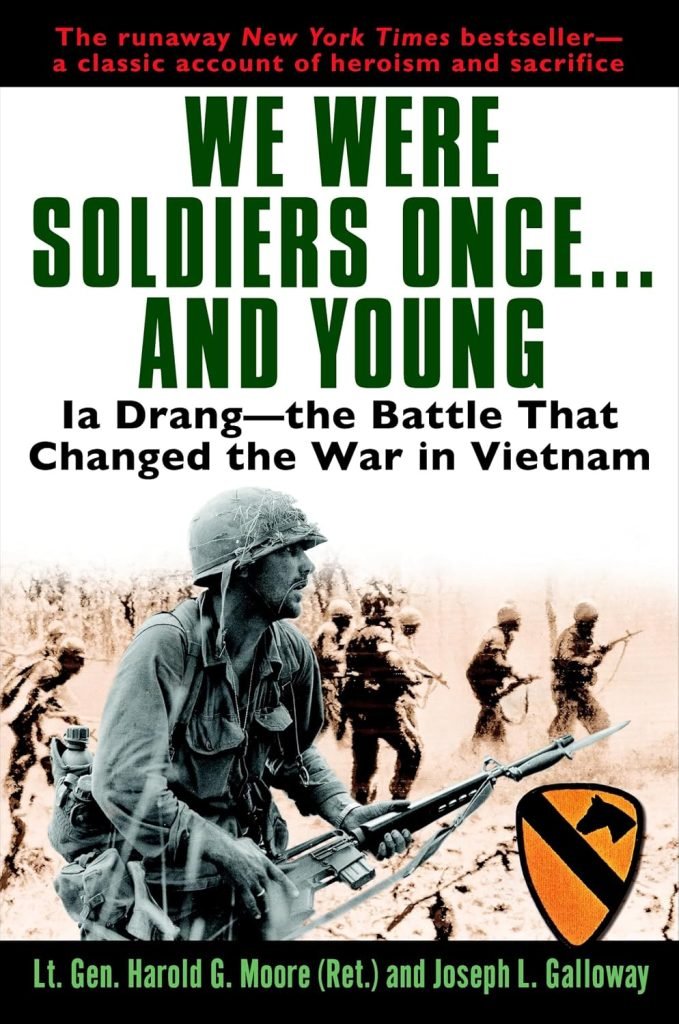
We Were Soldiers Once… and Young: Ia Drang, the Battle That Changed the War in Vietnam

We Were Soldiers Once… and Young: Ia Drang, the Battle That Changed the War in Vietnam

Ia Drang, the Battle That Changed the War in Vietnam

Category:History
Publisher:Random House
Published:October 20, 1992
ISBN:0679411585
ISBN:9780679411581
Language:English
Share:

Buy Now

Description:

TL;DR

The account of the November 1965 Battle of the Ia Drang Valley, written by the battalion commander who led it, Hal Moore, and Joseph Galloway, the reporter who fought beside his men. It became the 2002 film We Were Soldiers.

In November 1965, Lieutenant Colonel Hal Moore led about 400 men by helicopter into a clearing in Vietnam’s Central Highlands called Landing Zone X-Ray. They landed close to a force several times their size. For three days, the first major battle between American and North Vietnamese troops was fought around that clearing.

Joseph Galloway, a 24-year-old UPI reporter, was there with a rifle.

Twenty-seven years later he and Moore wrote the book.

What happens in We Were Soldiers Once… and Young?

The Battle of the Ia Drang Valley, told from the ground. It follows Moore’s 1st Battalion, 7th Cavalry through the air assault and the fight at X-Ray, and then the ambush of a sister battalion marching to a clearing called Landing Zone Albany.

The authors built it from their own memories and from long interviews with the men who survived. Names, ranks and hometowns run through every chapter. The cover photograph shows one of the battalion’s young officers, Lieutenant Rick Rescorla. The book is about the soldiers far more than the strategy. Random House published it in October 1992. It became a New York Times bestseller and has been on the Marine Corps Commandant’s reading list for decades. In 2002 it was made into the film We Were Soldiers, with Mel Gibson playing Moore.

What makes We Were Soldiers Once… and Young different from most battle histories?

Most battle histories are written from the top down, from maps, orders and after-action reports. This one is written from inside the perimeter, by the man who commanded it and a reporter who fought in it, and it keeps returning to individual soldiers by name.

That’s slower reading than a strategic overview, and it’s the reason the book has lasted. Readers who have never served finish it knowing what three days at Landing Zone X-Ray cost particular people.

Who were Hal Moore and Joseph Galloway?

Moore graduated from West Point in 1945, fought in Korea and Vietnam and earned the Distinguished Service Cross at Ia Drang. He retired in 1977 as a lieutenant general.

His career ran from the last months of World War II to the end of Vietnam. He served with the 187th Glider Infantry in occupied Japan and with the 82nd Airborne before Korea. After Ia Drang he commanded a brigade of the 1st Cavalry Division and later the 7th Infantry Division in Korea, and he finished as the Army’s deputy chief of staff for personnel.

In retirement he worked for the Crested Butte ski area in Colorado. He died in Auburn, Alabama, at 94, and he’s buried at Fort Benning. Galloway went on to a long career as a war correspondent. In 1998 the Army awarded him the Bronze Star with “V” for carrying a wounded soldier to safety under fire at X-Ray, the only civilian it decorated for valor in combat in Vietnam. He later covered military affairs for Knight Ridder and died in 2021.

How was We Were Soldiers Once… and Young received?

Very well, by the people who knew the subject best. David Halberstam praised it, and so did Norman Schwarzkopf.

The 2002 film, directed by Randall Wallace, grossed about $115 million worldwide. Moore and Galloway later went back to Vietnam together and wrote a second book, We Are Soldiers Still, published in 2008.

Why does We Were Soldiers Once… and Young belong on this shelf?

It shows what a commander and a professional writer can do as equal partners. Moore brought the command decisions and the men. Galloway brought the reporting and the craft. Both names are on the cover.

The book is better than either could have written alone.

Keep reading

Hiring a ghostwriter for a retired general’s or admiral’s leadership book: how senior military leaders turn a career into a book, and what has to stay out.

Frequently Asked Questions

What is We Were Soldiers Once… and Young about?
It’s the account of the November 1965 Battle of the Ia Drang Valley, the first major battle between American and North Vietnamese forces, written by the U.S. battalion commander, Hal Moore, and reporter Joseph Galloway, who were both there.
Who wrote We Were Soldiers Once… and Young?
Lieutenant General Harold G. Moore, who commanded the 1st Battalion, 7th Cavalry at Ia Drang, and Joseph L. Galloway, the UPI reporter who was on the ground with the battalion. Both are credited as authors.
Was We Were Soldiers Once… and Young made into a movie?
Yes. Paramount released We Were Soldiers in March 2002, directed by Randall Wallace, with Mel Gibson as Hal Moore.
When was We Were Soldiers Once… and Young published?
Random House published it in October 1992. It became a New York Times bestseller.
Was Joseph Galloway a soldier?
No. He was a civilian war correspondent, but in 1998 the Army awarded him the Bronze Star with V device for carrying a wounded soldier to safety under fire at Landing Zone X-Ray.
Is there a sequel to We Were Soldiers Once… and Young?
Yes. Moore and Galloway wrote We Are Soldiers Still, published in 2008, about returning to the battlefields of Vietnam.
Categories and tags
CategoriesMemoirs

About the author

Lt. Gen. Harold G. Moore (Ret.) and Joseph L. Galloway

Harold G. Moore

Lieutenant General Harold G. Moore, known as Hal, commanded the 1st Battalion, 7th Cavalry at Landing Zone X-Ray in the Ia Drang Valley in November 1965 and earned the Distinguished Service Cross there. A 1945 West Point graduate who fought in Korea and Vietnam, he wrote We Were Soldiers Once... and Young and We Are Soldiers Still with Joseph Galloway.…

More about Harold G. Moore

Joseph L. Galloway

Joseph L. Galloway was a war correspondent who, as a 24-year-old UPI reporter, fought alongside Hal Moore's battalion at Landing Zone X-Ray in 1965. He later received the Bronze Star with V for rescuing a wounded soldier under fire there. He co-wrote We Were Soldiers Once... and Young and We Are Soldiers Still with Moore, and died in 2021.

More about Joseph L. Galloway

Back