Latest
Hiring a Ghostwriter for a Family Business History BookHiring a Ghostwriter for a Retired General’s or Admiral’s Leadership BookHiring a Ghostwriter for a Sheriff’s or Police Chief’s BookWhat the AI Writing Survey Says About Jobs, Freelancers and Fiction AuthorsHow Long Does Google Take? Crawling, Indexing and Recovery TimesLife of Pi50 Years of Duty: One Police Officer’s Compelling Journey from State Trooper to County SheriffBreaking Rank: A Top Cop’s Exposé of the Dark Side of American PolicingBlack in Blue: Lessons on Leadership, Breaking Barriers, and Racial ReconciliationCalled to Rise: A Life in Faithful Service to the Community That Made MeVigilance: My Life Serving America and Protecting Its Empire CityTurnaround: How America’s Top Cop Reversed the Crime EpidemicCollaborate or Perish! Reaching Across Boundaries in a Networked WorldThe Profession: A Memoir of Community, Race, and the Arc of Policing in AmericaSTEP-UP and LEAD: A Guide for Dynamic, Innovative Leadership in Law EnforcementStriving for Justice: A Black Sheriff in the Deep SouthThe Diagram GalleryGar Travis: A Tribute to One of the Best Faire PhotographersReverse Tropes: Six Ways to Turn a Tired Trope Inside OutA Hiker Used AI to Find a Waterfall. The Forum Sent Her to Hell.Did We Miscount the World’s Population? What the Rural Undercount MeansFrankenstein’s Creature Has Worn Many Faces. Only One Is Mary Shelley’sIs Consciousness Quantum? Penrose Is Half RightAI Companies Are Preparing for a Catastrophe. Which One?Petty Motivations Make Characters HumanAnatomy of a Writer: The Parts That Do the Real WorkGuillermo del Toro’s Writing Advice: Love Your MonstersFree Book Marketing: Seven Ways That Cost Time Instead of MoneyMy Sister Built the Family We Never HadShould Your AI Report You to the Police?Anthropic Bans Cruelty Toward Claude: What It Means for WritersWork-for-Hire Contracts: What the Asimov’s Cover Fight Teaches FreelancersGenre Fiction vs Literary Fiction: Don’t Confuse Taste With SkillFlorida Hurricane Prep Rituals: The Grocery Run, the Water Pallet and the Generator in the BoxThe Most Insulting Line of Dialogue Ever Written for the ScreenLoki Through the Ages: From Norse Myth to Marvel, The Mask and Dogma“You Are Utterly Disgusting”: A Book Festival, an AI Cover Ban and a Pile-OnWho Rewrote the Sligachan Legend: AI or the Tour Buses?Layers: How I Ride Out Florida Power Outages in My ApartmentWhy I Don’t Like Reedsy for Ghostwriting: The NDA ProblemThe Enshittification of AmazonPublishers Cancel Books Over AI While Using It in SecretI Was Getting 100 Spam Emails a Day. $4.50 a Month Fixed It.World Mental Health Day: Nothing Was Wrong With MeKessler Syndrome: How Space Debris Could Close Earth’s OrbitAmazon Is Blocking Real Readers From Book ReviewsShould a Novella Get a Paperback, or Go Ebook Only?BookFunnel Download Problems: Fixes, Scams and AlternativesSir Sean Connery: A TributeHow to Find Plot Holes in Your Novel (Most Are Character Holes)
The Writing King Your Ethical Ghostwriter. Your Story, Done Right.

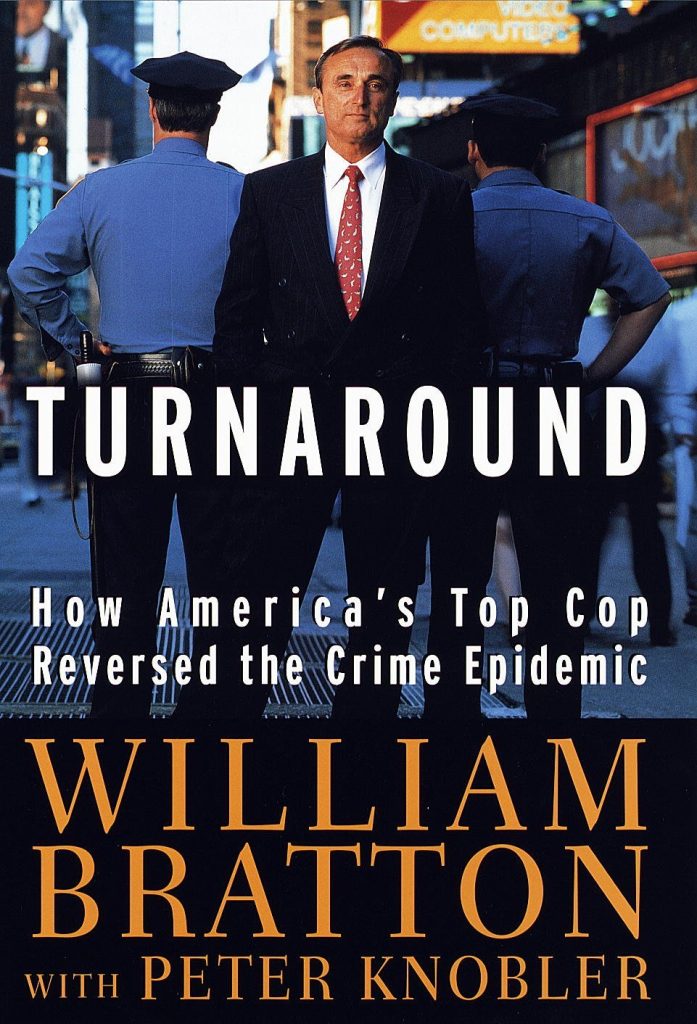
Turnaround: How America’s Top Cop Reversed the Crime Epidemic

Turnaround: How America’s Top Cop Reversed the Crime Epidemic

How America's Top Cop Reversed the Crime Epidemic

Publisher:Random House
ISBN:0679452516
ISBN:9780679452515
Language:English
Share:

Buy Now

Description:

TL;DR

Bill Bratton’s first memoir, written with Peter Knobler in 1998, about a career spent turning around troubled police agencies, culminating in his 27 months as New York police commissioner. Part memoir, part management book.

Bill Bratton was second in command of the Boston police in his early thirties. Then he told a reporter he wanted to be commissioner one day, and the department demoted him for it. Turnaround is full of moments like that, where ambition costs a man something and he keeps going anyway.

Random House published it in early 1998, less than two years after Bratton left the New York Police Department. He wrote it with Peter Knobler.

What is Turnaround by Bill Bratton about?

A career built on fixing broken agencies. Bratton grew up working class in Dorchester and wanted to be a cop from boyhood. He came up as a reformer in Boston, then ran one troubled department after another: the MBTA police, the Metropolitan District Commission police and, from 1990, the New York City transit police.

In the subways he went after fare-beaters with fast arrests and fast processing. His theory was that people jumping the turnstiles were often wanted for something else, and the arrests turned up weapons and warrants. After a short stint as Boston’s commissioner, he became New York police commissioner in 1994 with a promise to fight crime in every borough.

How did CompStat start at the NYPD?

The center of the book. It started as pins stuck in maps and grew into a weekly process of crime data, mapped by precinct, with commanders held personally accountable for what the maps showed. Bratton paired it with the broken windows theory of George Kelling and James Q. Wilson. The theory holds that tolerating small disorder invites larger crime.

The book reports that serious crime in New York fell by a third during his 27 months, and the murder rate was cut in half. Police departments around the world later copied CompStat.

Why did Bratton leave the NYPD?

The book gives his side of a public falling-out with City Hall over who deserved credit for the falling crime numbers. The tension started in his first week, over his press coverage, and ended with his resignation in April 1996. Bratton presents it as a clash of personalities. Readers outside New York may find those chapters less interesting than the rest, and at least one review said so.

How was Turnaround received?

Kirkus called it surprisingly readable and reasonable and told readers to get it. The New York Times named it a Notable Book of the year. Readers since have treated it as much as a management book as a police memoir, and that’s a fair way to read it. The lessons about taking over a demoralized organization, hiring people who’ll argue with you and measuring everything apply well outside policing.

Who is Peter Knobler?

Bratton’s co-writer on Turnaround came to the project from journalism and music. Peter Knobler ran Crawdaddy!, the rock magazine, as editor-in-chief through most of the 1970s, then built a second career writing books with public figures, including basketball great Kareem Abdul-Jabbar and Texas governor Ann Richards.

That background shows in the book. It moves like a story, with scenes and characters. Bratton wrote it after leaving the NYPD, while working in the private sector, and the distance of a year or two gave him room to tell it with some perspective while the details were still sharp. It’s a good example of what a professional collaborator brings: the leader supplies the career and the judgment, the writer supplies the shape.

What Turnaround shows a leader planning a book

Because of when it was written. Bratton wrote it while the numbers were fresh and the arguments were still going. A leader who writes that soon gets a book with names, numbers and fights in it. Wait twenty years and the memory smooths everything over.

It’s also a collaboration that worked. Peter Knobler, a former magazine editor who has written books with athletes and politicians, wrote it with Bratton, and the two worked together again on The Profession in 2021. Two books, two decades apart, with the same writer: that’s what a good collaboration looks like.

Keep reading

Hiring a ghostwriter for a sheriff’s or police chief’s book: how law enforcement leaders turn a career into a book, and what has to stay out.

Frequently Asked Questions

What is Turnaround by Bill Bratton about?
It’s Bratton’s 1998 memoir, written with Peter Knobler, about a career spent turning around troubled police agencies in Boston and New York. It centers on his 27 months as NYPD commissioner, the creation of the CompStat system and the drop in crime that followed, and it ends with his resignation in 1996.
What is the NYPD’s CompStat system?
It’s the crime-mapping and accountability system Bratton’s NYPD developed in the mid-1990s. It began as pins in maps and grew into regular meetings where precinct commanders reviewed mapped crime data and answered personally for the results. Police departments around the world later adopted versions of it. Turnaround tells how the system was born, from inside the room.
Why did Bill Bratton resign from the NYPD in 1996?
In Turnaround, Bratton describes a public falling-out with City Hall over who deserved credit for New York’s falling crime rate, with tension starting in his first week. He resigned in April 1996 after about 27 months as commissioner, and presents the conflict as a clash of personalities. Critics and supporters of both men still argue over who deserved the credit.
Who co-wrote Turnaround?
Peter Knobler, a former editor-in-chief of Crawdaddy! magazine who has written books with Kareem Abdul-Jabbar, Ann Richards and others. He later co-wrote Bratton’s 2021 memoir, The Profession, as well, making it a collaboration that lasted two decades. Knobler’s background in magazine journalism helped give the book the pace of a story instead of a report.
Is Turnaround a management book?
It’s a memoir, but many readers use it as a management book. Its lessons on taking over a demoralized organization, hiring deputies who’ll push back, setting clear goals and measuring results apply in almost any field, and that’s a large part of why it’s still read. Business readers often shelve it next to books on corporate turnarounds.
How was Turnaround reviewed?
Kirkus called it surprisingly readable and reasonable and recommended it, and the New York Times named it a Notable Book of the year. Some reviewers found the chapters on City Hall politics of less interest to readers outside New York than the policing chapters. More than twenty-five years later, readers still recommend it for its lessons on leadership.
Categories and tags
CategoriesMemoirs

About the author

William Bratton with Peter Knobler

Back