TL;DR
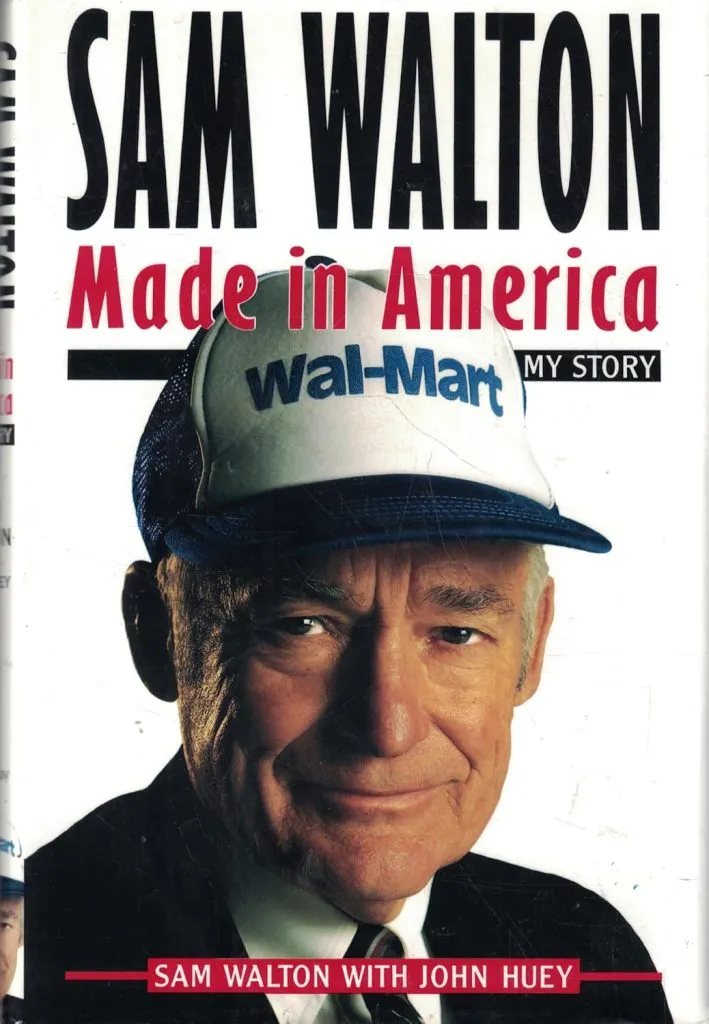
Sam Walton’s own account of building Walmart from a variety store in Arkansas, written with Fortune editor John Huey and published shortly after Walton died in 1992. It’s the founder’s memoir of the biggest family business story in American retail.
Sam Walton ran a variety store in Newport, Arkansas, in 1945. He opened the first Wal-Mart in Rogers, Arkansas, in 1962. By the time he died in April 1992, it was the largest retailer in the world and his family was one of the richest in the country.
He told the story himself, in a book that came out just after he died.
Sam Walton: Made in America was written with John Huey, a senior editor at Fortune, and Doubleday published it in 1992, shortly after Walton’s death.
What does Sam Walton cover in Made in America?
Walton’s life and his business, in his own voice. He covers his childhood in Missouri, his business degree from the University of Missouri, his first Ben Franklin franchise and the five-and-dime he opened in Bentonville in 1950. From there he takes the reader through the first Wal-Mart Discount City in 1962 and the decades of growth that followed, store by store and town by town across the rural South and Midwest.
He also explains how he ran the company: partnership with employees, whom he called associates, relentless thrift, a love of competition and a list of rules for building a business.
He writes about his family, his money and the celebrity he never wanted.
Forbes had named him the richest man in America from 1985 to 1988.
How did John Huey come to write Made in America with Sam Walton?
Huey had landed one of Walton’s rare long interviews in 1989 for Fortune. That relationship turned into the book. Huey later became editor-in-chief of Time Inc.
How was Made in America received?
As a classic almost immediately. The New York Times Book Review called it a sure-fire all-American success story, and it has stayed in print for more than three decades in one edition after another.
What should a founder take from Made in America?
The rules. Walton ends with his ten rules for building a business, and they’re the most quoted pages in the book. They’re short, plain and practical, and every one of them comes out of a story told earlier in the book.
A founder’s memoir works best when the lessons come out of the stories instead of sitting on top of them. Walton tells you what happened for two hundred pages, and only then tells you what he thinks it means.
Why does Made in America belong on this shelf?
It’s the classic founder’s memoir, and it was written just in time.
Walton worked on it in the last years of his life. A professional writer who already knew him and the company made it possible to get the story down while he could still tell it. Without that collaboration, the most famous family business story in American retail would have been told by everyone except the man who lived it. Families waiting for the right moment to record a founder’s story have less time than they think.
Keep reading
Hiring a ghostwriter for a family business history: how families turn the story behind the business into a book before the people who remember it are gone.
- Sam Walton, Made in America: My Story, University of Southern Indiana Library
- Sam Walton (1918 to 1992), CALS Encyclopedia of Arkansas
- Sam Walton, Encyclopaedia Britannica
Frequently Asked Questions
Other Books From – Biography and Memoir