TL;DR
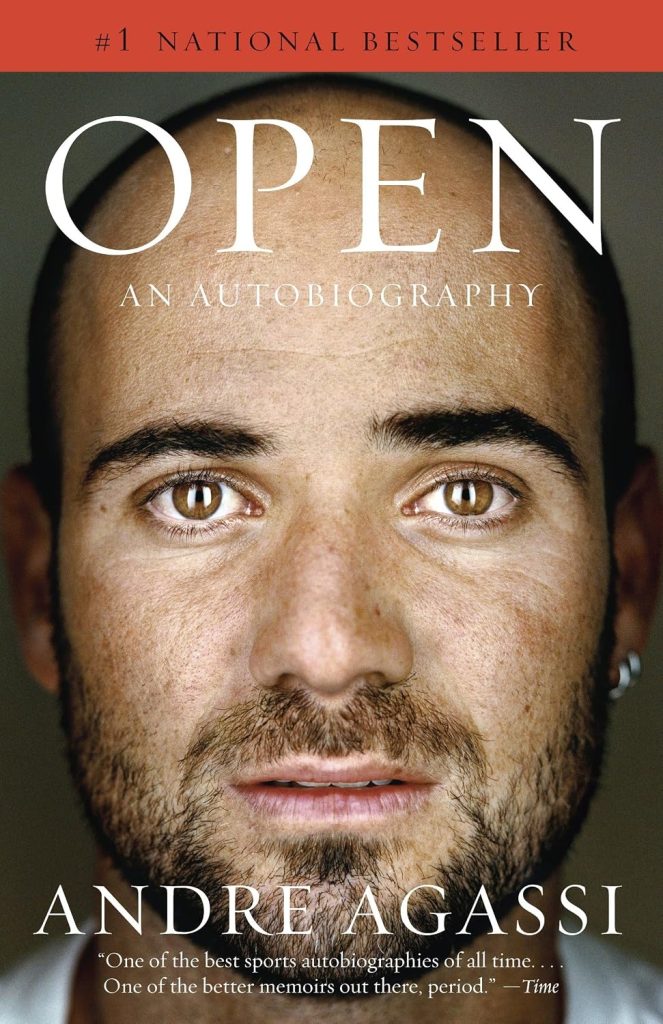
Andre Agassi’s 2009 memoir, written with Pulitzer-winning journalist J.R. Moehringer, in which he admits he hated tennis for much of his career. It’s my favorite answer to anyone who asks what a ghostwriter is for.
Andre Agassi opens his memoir by telling you he hates tennis. He means it, and he spends the next few hundred pages explaining why a man who won eight Grand Slam titles never chose the sport in the first place.
Open is my favorite answer to anyone who asks what a ghostwriter is for.
What is Open about?
The whole life, with nothing smoothed over. It starts with a boy in Las Vegas under a relentless father who built a ball machine to fire at him, and a mother who mostly stood aside. It covers his years at a Florida tennis academy, the rebellious image of the 1980s and the hairpiece he wore early in his career.
Then come the admissions that made news. Agassi wrote that he used crystal meth in 1997, failed a drug test, and lied to the tennis authorities about it with a letter blaming a spiked drink. They let him off with a warning.
Then the rest of the arc. The book also covers his marriage to Brooke Shields, his relationship and marriage with Steffi Graf, his comeback to win the 1999 French Open and complete a career Grand Slam, and his retirement at the 2006 US Open while his back was failing. The last match, played on cortisone shots, is the strongest chapter in the book.
Don’t skip the pages on Gil Reyes, the trainer who became the father figure Agassi never had at home, and on the charter school he built in Las Vegas for kids with no other good option.
Who wrote Open?
Agassi did, with J.R. Moehringer. Moehringer was a Pulitzer Prize-winning journalist who had just published his own memoir, The Tender Bar. He’d won the Pulitzer for feature writing in 2000 at the Los Angeles Times. Agassi read The Tender Bar and decided that was the writer he wanted. Agassi offered him a credit on the cover, and Moehringer turned it down, on the grounds that the story belonged to Agassi. Moehringer spent long stretches with him, and the book that came out of it sounds like nobody but Agassi.
Moehringer went on to work on Phil Knight’s Shoe Dog and Prince Harry’s Spare. Most of the public learned his name only after Open came out, and the book’s reputation rose when they did.
How was Open received?
It hit number one on the New York Times bestseller list. Sam Tanenhaus wrote in the Times that it was far more than a sports memoir, a real coming-of-age story. It won the British Sports Book Award.
Why does Open matter to anyone writing a memoir?
Because it’s honest in the places most memoirs flinch. Agassi wanted the real book: the father, the drugs, the lie, the hatred of the thing he was best at. Most celebrity memoirs are sanitized because the subject is protecting an image. This one works because he let it go.
And because it proves the collaboration doesn’t cost the author his voice. Every page sounds like Agassi.
That’s the job done right.
Keep reading
Moehringer and Agassi: how the most admired sports memoir of its era got written, and what it shows about ghostwriting.
Frequently Asked Questions
Other Books From – Biography and Memoir