TL;DR
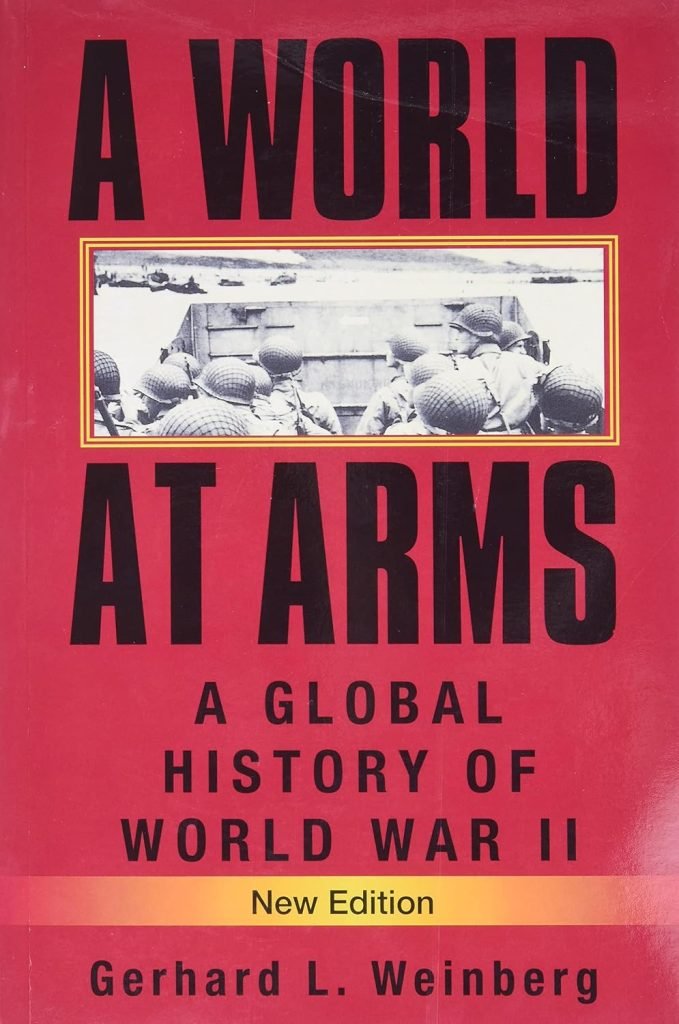
Gerhard Weinberg’s one-volume history of World War II across every continent, more about why things happened than about the battles. It’s one of the two nonfiction books I keep rereading.
Two nonfiction books sit on my reread pile, and people are surprised by that because neither one is light. A World at Arms is the heavier of the two, a single volume that runs well over a thousand pages.
I’ve read it several times anyway.
What is A World at Arms about?
The whole war, everywhere at once. Cambridge University Press published it in 1994 as a global history of World War II, and it means global: six continents, the Axis, the Allies and the neutral countries, every theater.
What sets it apart is everything behind the battles: the politics, the demographics, the geography, the food and the raw materials and the supply. Weinberg explains why things happened. Why Hitler felt he had to attack Russia. Why a decision in one capital set off a chain of consequences on the other side of the world. He keeps showing how events in one theater shaped what happened in another. Most war histories never manage that.
It opens with how Europe and its empires were remade after World War I, so the reader understands the board before the pieces start moving. It closes with a long bibliographic essay that’s a reading list in its own right.
Who is Gerhard Weinberg?
Weinberg was born in Hanover, Germany, in 1928. His family left for England in 1938 and New York in 1941. He earned his doctorate at the University of Chicago, taught at Kentucky and Michigan, and spent the rest of his career at the University of North Carolina at Chapel Hill. He also edited and translated Hitler’s unpublished second book.
How was A World at Arms received?
About as well as a history book can be. It won the American Historical Association’s George Louis Beer Prize in 1994. Historians including Ian Kershaw, Norman Stone and Andrew Roberts praised it, and David Reynolds called it a tour de force in the New York Times. American Heritage rated it the finest one-volume history of the war.
Cambridge put out a second edition with a new preface in 2005.
Is A World at Arms worth the time for writers?
Anyone who wants to understand the war instead of just following it. It’s a long commitment, and the payoff is that afterward the battles make sense. Writers working on anything set in the 1940s will find the background they need here, and they’ll find it explained.
Background is where historical fiction usually fails. A novel set in 1943 goes wrong when the writer knows the battles and not the rationing, the shipping losses, the politics in the capitals and what ordinary people in a neutral country could and couldn’t buy. Weinberg covers all of that, and he covers it across every continent, so a writer can check what was happening on the far side of the world on the day a scene takes place.
The taste goes back a long way for me. The first adult book I read, at seven, was a history of Iwo Jima. I’ve been reading about the war ever since.
Keep reading
The books I reread: why two heavy histories sit on my reread pile next to the novels.
Frequently Asked Questions
Other Books From – History