TL;DR
7/10. A structured day-by-day program that imposes a schedule on the unstructured process of writing a novel, with craft instruction folded in just when each skill is needed. The hype-y title hides a sound method. Strong for the writer who can write but never finishes; less suited to those who resist a regimented pace.
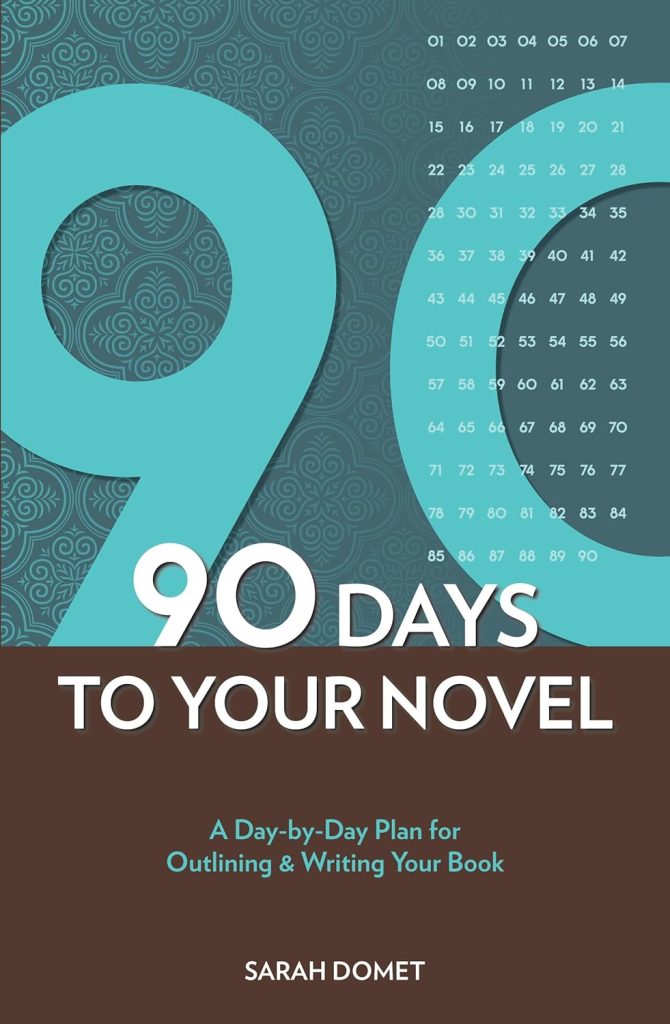
The promise in the title of 90 Days to Your Novel sounds like the worst kind of writing-industry hype, and Sarah Domet knows it. That title is eye-roll bait, and it sells a better book short. It’s a structured, day-by-day writing program with a realistic premise. What stops most people from finishing a novel is the lack of a plan and the discipline to follow it. Talent isn’t the problem.
Domet is a writer and teacher, and the book is built like a course with a syllabus. The ninety-day frame is the organizing device, a way to turn the overwhelming abstraction of write a novel into a sequence of concrete daily tasks.
The structure as the selling point
The book’s real value is that it imposes structure on a famously unstructured process.
Domet breaks the work into daily and weekly assignments. Brainstorming and planning first. Then drafting in disciplined increments. Then early revision. Domet defines each day’s task, so the writer always knows what to do next. For the writer who has started a dozen novels and finished none, this scaffolding is the missing piece. It converts a vague intention into a schedule, and a writer can keep a schedule.
The famous-authors-write-fast framing in the marketing is cheap bait, and I could do without it. The underlying method, daily accountable progress toward a finished draft, is sound as hell.
Keep reading
Building a daily writing habit that actually sticks: the discipline Domet’s schedule enforces, as a lasting practice.
Watch: Can You Write a POLISHED Novel in Just 3 Months?, Inimitable Books
The craft alongside the calendar
It’s more than a calendar, and that lifts it above a simple challenge like the month-long novel-writing events.
Domet folds in real instruction as the ninety days progress, covering plot, character, scene, dialogue, and point of view at the point in the schedule where the writer needs each one. The teaching is solid without being groundbreaking, a competent survey of fundamentals. Embedding it in the daily program means the writer learns and applies in the same motion, instead of reading theory in the abstract.
That integration of instruction and scheduled practice is the book’s smartest feature. Most craft books dump all the theory up front and leave you to remember it three months later. Domet hands you dialogue advice the week you’re writing dialogue. That’s how it should be done.
Keep reading
Writing a first draft: how to get the full story down: the disciplined drafting Domet’s program is built around, in depth.
Who is 90 Days To Your Novel best for?
The caveats are real. The ninety-day deadline is motivating for some and stressful for others, and a writer who doesn’t thrive under that kind of structure may find the regimented pace counterproductive instead of helpful.
It’s worth comparing to the month-long novel-writing challenges many writers know, because the comparison shows what Domet does differently and better. Those events are pure word-count sprints: write fifty thousand words in a month, no instruction, no plan, just volume. They get words on the page but often produce an unusable mess, because speed without structure is just fast chaos. A word count nobody can revise is a dumb thing to brag about.
Domet’s ninety days are slower and scaffolded, with planning built in before the drafting starts and craft instruction delivered along the way, so what you have at the end is a draft built on a foundation instead of a heap of panicked wordage. For a writer who has done a sprint challenge and ended with something unsalvageable, the difference is instructive: the constraint is a sequence as much as a deadline, and the sequence makes the output workable.
The craft instruction, while sound, is a survey instead of a deep treatment, so a writer using this as their only resource will get fundamentals but not mastery. And the rigid day-by-day plan assumes a life with room for daily writing, which not every aspiring novelist has. The method works best for the self-directed writer who lacks structure, less well for those whose problem is something else.
Is 90 Days To Your Novel worth reading?
It’s a useful program for the right writer: the one who can write but can’t finish, who needs a plan and external structure to convert intention into a completed draft. The integration of daily scheduling with just-in-time craft instruction is smart and effective, and the realistic core beneath the hype-y title delivers. It loses a little for the one-size pace that won’t suit everyone and for craft coverage that stays at the survey level.
For the disciplined-but-stuck novelist, a strong recommendation; for others, a useful structure to adapt instead of follow to the letter.
Explore the hub
The Writing Hub: drafting, habit, and finishing what you start, gathered in one place.
Frequently Asked Questions
Other Books From – Writing and Language



About the author