
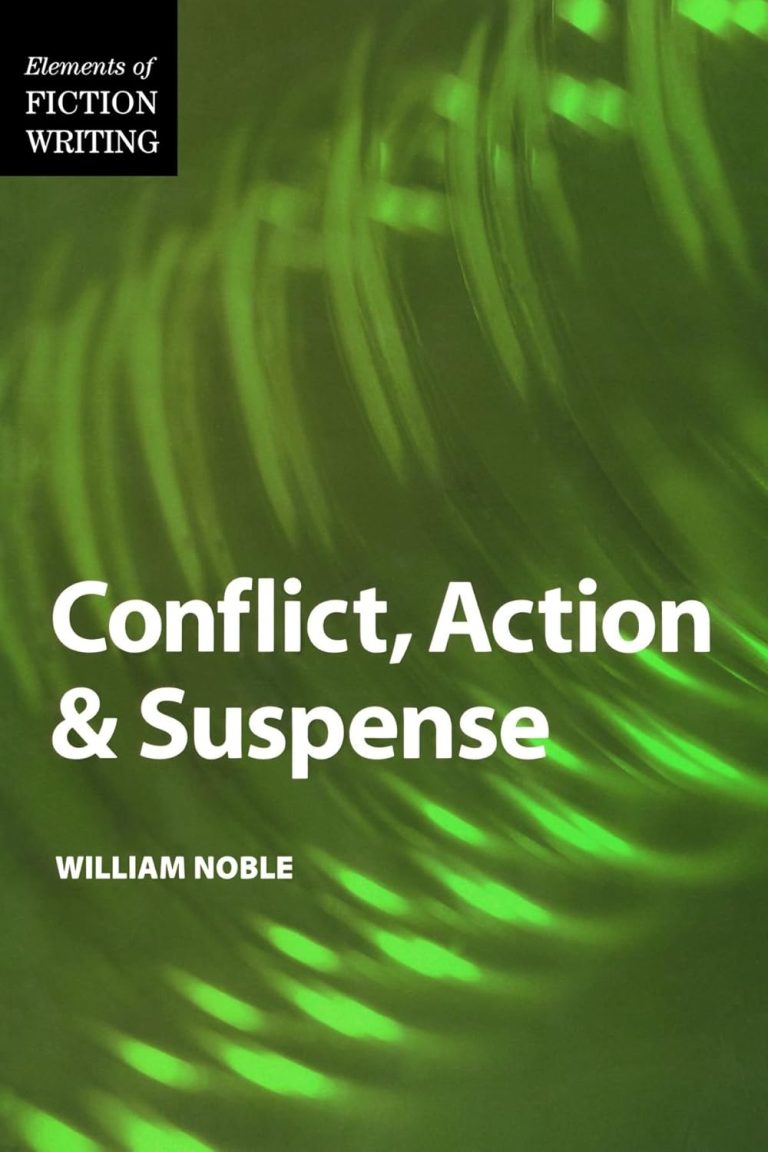
William Noble is an American writing-craft author and a longtime contributor to the Writer's Digest Elements of Fiction Writing series, best known for Conflict, Action and Suspense (Writer's Digest, 1994), one of the most consistently in-print working references on dramatic tension in fiction. He has published more than forty books across fiction, nonfiction, and writing-craft instruction, with a focus on the working mechanics of what makes a reader stay glued to a page.
Conflict, Action and Suspense works from the foundational premise that the writer-reader partnership is the working contract of fiction: readers expect writers to fashion a story they can stay glued to, and writers expect readers to stay glued. Working chapters cover what constitutes conflict at the scene level, what constitutes action at the scene level, the working machinery of suspense (cliff-hangers, dialogue, mood, character development, point of view, subtlety and indirection, time and place), the working logic of pacing (giving the reader a breather, pushing crisis, the working balance of narrative and dialogue), and the working mechanics of endings (surprise, delight, questions and choices, the circular versus the linear resolution).
His other Writer's Digest titles in the working craft library include Show, Don't Tell, Make That Scene, and Three Rules for Writing a Novel: A Guide to Story Development, all of which extend the same writer-reader-partnership argument to other working dimensions of fiction. His book Shut Up! He Explained: A Writer's Guide to the Uses and Misuses of Dialogue (Paul S. Eriksson, 1987) takes on dialogue as its own working topic, and Bookbanned: Censorship in America Today and Other Nonfiction Titles cover the working business of publishing and the politics of reading.
William Noble
Professional ghostwriting for executives, founders, coaches, and authors who want to get the book done right. 113+ books authored. 54+ ghostwritten for clients.
Ready to discuss your book?
BOOK YOUR PRIVATE CONSULTATIONNo pitch. No pressure.
© 2026 Richard Lowe. The Writing King. All rights reserved.